Sandhill Crane December 2025 Bird of the Month
Each month I will feature a bird that I have photographed. Not only will I show some of my photos but will also include information about the bird.
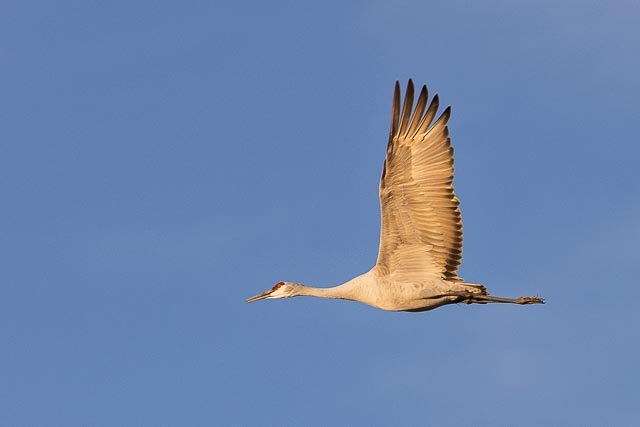
Adults are gray overall; during breeding, their plumage is usually much worn and stained, particularly in the migratory populations, and looks nearly ochre. The average weight of the larger males is 10.1 lb, while the average weight of females is 8.9 lb, with a range of 6.0 to 14.8 lb across the subspecies. Sandhill cranes have red foreheads, white cheeks, and long, dark, pointed bills. In flight, their long, dark legs trail behind, and their long necks keep straight.
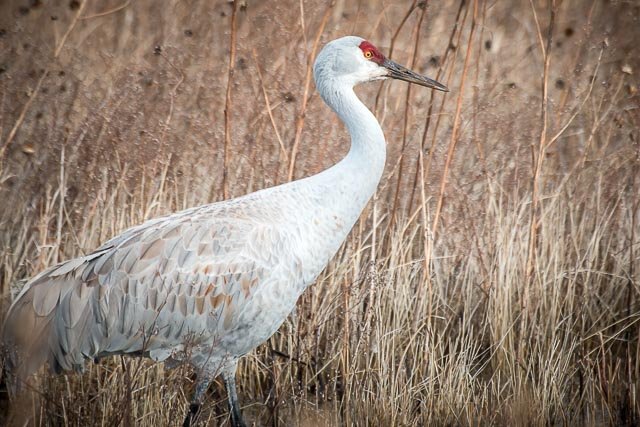
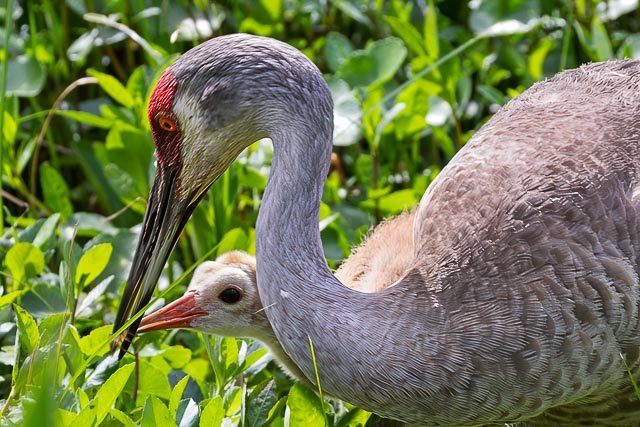
Immature birds have reddish-brown upper parts and gray underparts. The juveniles do not have the characteristic red foreheads, making distinguishing the young from the parents possible, even when they are the same height.
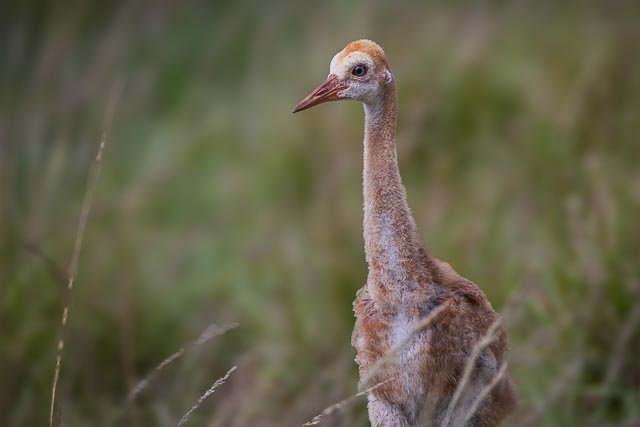
The sexes look alike. Sizes vary among the different subspecies; the typical height of these birds is around 2 ft 7 in to 4 ft 6 in.
These cranes frequently give a loud, trumpeting call that suggests a rolled “r” in the throat, and they can be heard from a long distance. Mated pairs of cranes engage in “unison calling”. The cranes stand close together, calling in a synchronized and complex duet. The female makes two calls for every one from the male.
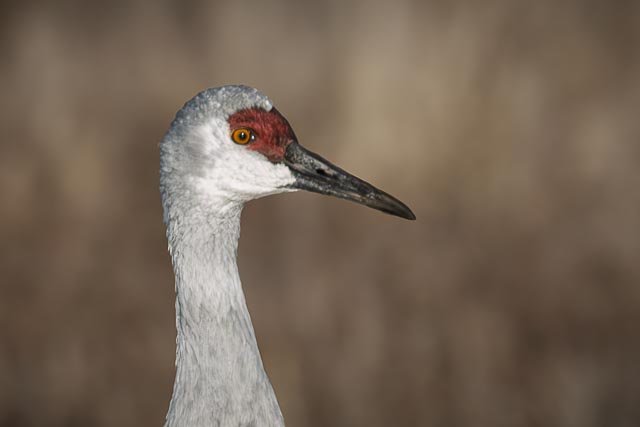
Sandhill cranes’ large wingspans, typically 5 ft 5 in to 7 ft 7 in, make them very skilled soaring birds, similar in style to hawks and eagles. Using thermals to obtain lift, they can stay aloft for many hours, requiring only occasional flapping of their wings, thus expending little energy. Migratory flocks contain hundreds of birds, and can create clear outlines of the normally invisible rising columns of air (thermals) they ride.
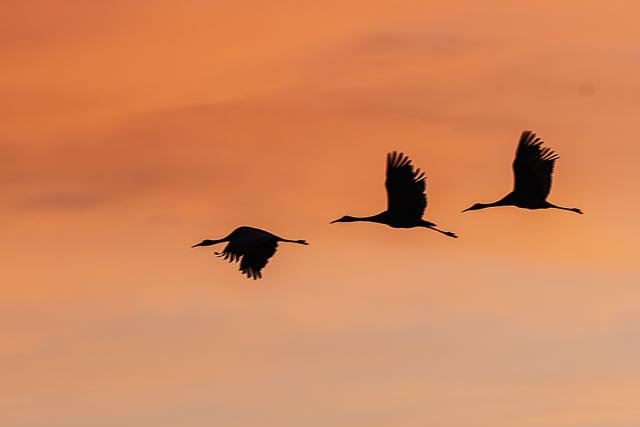
Sandhill cranes fly south for the winter. In their wintering areas, they form flocks over 10,000. One place this happens is at Bosque del Apache National Wildlife Refuge, 100 miles south of Albuquerque, New Mexico.
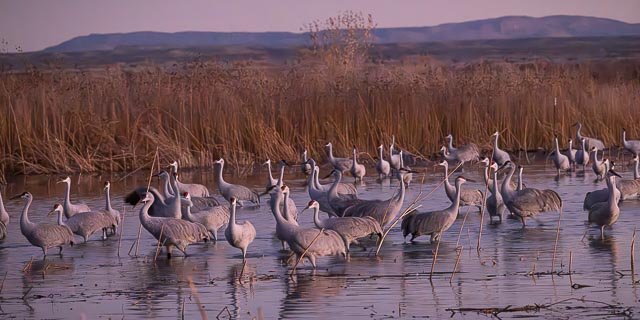
Sandhill cranes are fairly social birds that usually live in pairs or family groups through the year. During migration and winter, unrelated cranes come together to form “survival groups” that forage and roost together. Such groups often congregate at migration and winter sites, sometimes in the thousands.

Diet
Sandhill cranes are mainly herbivorous, but eat various types of food, depending on availability. They often feed with their bills down to the ground as they root around for seeds and other foods, in shallow wetlands with vegetation or various upland habitats. Cranes readily eat cultivated foods such as corn, wheat, cottonseed, and sorghum. Waste corn is useful to cranes preparing for migration, providing them with nutrients for the long journey. Among northern races of sandhill cranes, their diet is most varied, especially among breeding birds. They variously feed on berries, small mammals, insects, snails, reptiles, and amphibians.