Minnesota Photographic Destinations

Voyagers National Park Phelps Mill Lake Itasca State Park - Headwaters of the Mississippi Pipestone National Monument Split Rock Lighthouse

Let me help you to find a great location in Minnesota for your next photography adventure.  I will list many lesser known destinations, as well as the famous “Icon Locations” for photography.  I will provide photos (Lots of Photos), location information,  consisting of what there is to photograph as well as other information about the destination.  I will give costs, maps, directions, contact information, and other essential information for a successful photo trip.  I will only post for locations that I have personally photographed to insure a quality  guide to great locations for photography in Arkansas.

Interactive Google Map

Use the map  + – controls to zoom in and out, use the Map drop-down to change to “Map”, “Satellite”, “Hybrid”, or “Terrain” views.  Drag the little man icon from the upper left corner to a map location for street level view. Click on a pushpin for more information about the Photographic Destination, then click on the title to go to the location page.


Minnesota Photographic Destinations

Minnesota Destinations
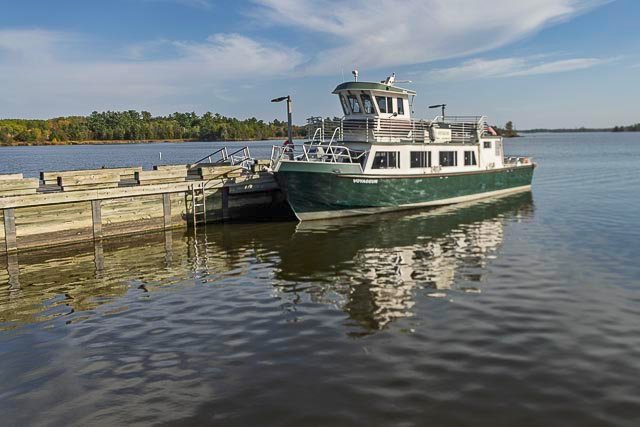
Voyagers National Park Voyageurs National Park is a national park of the United States in northern Minnesota established in 1975. It is located near the city of International Falls. The park’s name commemorates the voyageurs—French-Canadian fur traders who were the first European settlers to frequently travel through the area. Notable for its outstanding water resources, the park is popular with canoeists, kayakers, other boaters, and fishermen. The Kabetogama Peninsula, which lies entirely within the park and makes up most of its land area, is only accessible by boat. To the east of the park lies the Boundary Waters Canoe Area Wilderness. The park has several boat ramps and visitor centers on its periphery, though the main body of the park is only accessible by boat or, in the winter, by snowmobile, ski, or snowshoe. In 2018, the park hosted 239,656 visitors. Where it is: Voyageurs National Park is located in Northern Minnesota, near the Canadian border. The park’s visitor centers and some trails can be reached by car, but much of its beauty is best explored by boat. All campsites (except primitive) require a boat to reach. Access to Voyageurs is available from many points along Rainy Lake, Kabetogama Lake, Ash River, Crane Lake, and Orr/Pelican Lake. The largest city near Voyageurs National Park is International Falls, Minnesota. Unlike many other national parks, where the main access to the park is by motor vehicle, bicycle or foot, the primary access to Voyageurs is via water. Many visitors travel by kayaks and canoes, while others rent houseboats or take a guided tour boat. Rainy Lake Visitor Center 1797 Township Rd 342 International Falls, MN 56649 Kabetogama Lake Visitor Center 9940 Cedar Ln Kabetogama, MN 56669 Ash River Visitor Center 9899 Mead Wood Rd Orr, MN 55771 Maps:   GPS: Links: Voyagers National Park Hours: The park is open year-round; have fun exploring in all seasons! Visitor center open hours and closures vary by season, but Voyageurs National Park remains open and free to access year-round. With no entrance fees, you’re welcome to explore and enjoy the park any time of year. During the warm months of summer, the park is a destination for those who enjoy exploring by boat or hiking through northern forests. The interconnected waterways and miles of shoreline offer unparalleled opportunities for adventure. In winter, Voyageurs transforms into a snowy wonderland. Frozen lake surfaces provide access for snowmobiling, while park trails invite exploration on snowshoes or cross-country skis. Cost: There is no fee to enter Voyageurs National Park. Location Contact Information: Mailing Address: Voyageurs National Park Headquarters 360 Hwy 11 East International Falls, MN 56649 Phone: (218)-283-6600 Email General Information Camping Reservations Boat Tours Commercial Use Permits Special Use Requests Voyagers National Park Photo Gallery Click Here for full page gallery     More Photographic Destinations in Minnesota Interactive Google Map Use the map  + – controls to zoom in and out, use the Map drop-down to change to “Map”, “Satellite”, “Hybrid”, or “Terrain” views.  Drag the little man icon from the upper left corner to a map location for street level view. Click on a pushpin for more information about the Photographic Destination, then click on the title to go to the location page. Click Here for Photographic Destinations by State [...]Read more...
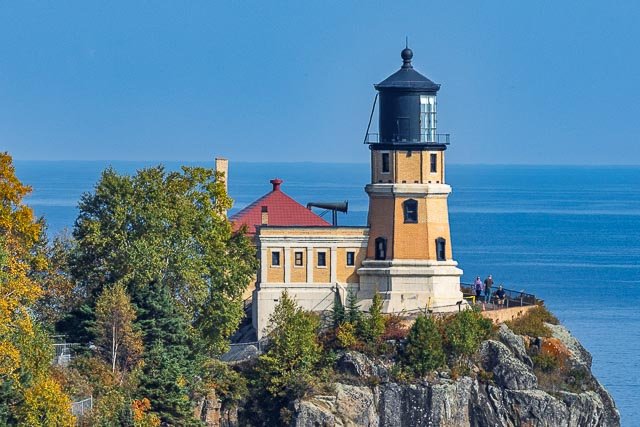
Split Rock Lighthouse Split Rock Lighthouse is a lighthouse located southwest of Silver Bay, Minnesota, US on the North Shore of Lake Superior. The structure was designed by lighthouse engineer Ralph Russell Tinkham and was completed in 1910 by the United States Lighthouse Service for $75,000, including the buildings and the land. It is considered one of the most picturesque lighthouses in the United States. Split Rock Lighthouse was built in response to the great loss of ships during the famous Mataafa Storm of 1905, during which 29 ships were lost or damaged on Lake Superior. One of these shipwrecks, the Madeira, is located just north of the lighthouse. The lighthouse stands on a 133-foot sheer cliff eroded by wave action from a diabase sill containing inclusions of anorthosite. The octagonal building is a steel-framed brick structure with concrete trim on a concrete foundation set into the rock of the cliff. It is topped with a large, steel lantern which features a third order, bi-valve type Fresnel lens manufactured by Barbier, Bernard and Turenne Company in Paris. The tower was built for a second-order lens, but when construction went over budget, only enough funding remained for the smaller third-order lens. The lens floats on a bearing surface of liquid mercury which allows near frictionless operation. The lens is rotated by an elaborate clockwork mechanism that is powered by weights running down the center of the tower which are then reset by cranking them back to the top. When completed, the lighthouse was lit with a kerosene oil vapor lamp. At the time of its construction, the area had no roads. All building materials and supplies arrived by water and were lifted to the top of the cliff by crane. The lamp was first lit on July 31, 1910. The lighthouse soon became a tourist attraction for sailors and excursion boats thanks to its scenic location. So much so, that in 1924 a road (now Minnesota State Highway 61) was built to allow land access. In 1940, the station was electrified, the lamp was replaced with a 1000-watt electric bulb, and the incandescent oil vapor lamp was moved to Au Sable Point Lighthouse in Northern Michigan. Split Rock was upgraded with a fog signal housed in a building next to the light tower. The original signal was a pair of sirens driven by two Franklin 30 hp gasoline-driven air compressors manufactured by Chicago Pneumatic Tool Company. In 1932 gasoline engines were replaced with diesel engines. The steam sirens were replaced with a Type F-2-T diaphone (be-you) type signal in 1936. The station and the fog signal were electrified four years later, but discontinued in 1961. The light was retired in 1969 by the U.S. Coast Guard. The lighthouse is now part of the Split Rock Lighthouse State Park and is operated by the Minnesota Historical Society. The site includes the original tower and lens, the fog signal building, the oil house, and the three keepers’ houses. It is restored to appear as it did in the late 1920s. The site was added to the National Register of Historic Places in 1969. Notwithstanding its retirement, every November 10 the lighthouse emits a light in memory of the SS Edmund Fitzgerald which sank on that date in 1975. On June 30, 2011, the lighthouse was designated as a National Historic Landmark. Where it is: The historic site is located 20 miles north of Two Harbors and within Split Rock Lighthouse State Park. A convenient stop off Highway 61 makes it a favorite spot for Minnesota vacationers. Hike in from your campsite or drive in from your North Shore resort! Click map for larger view GPS: 47°12’0.7812″ N 91°22’1.3368″ W Hours: October 21, 2025 – January 1, 2026 Day Hours Monday 10:00 am – 4:00 pm Tuesday Closed Wednesday Closed Thursday 10:00 am – 4:00 pm Friday 10:00 am – 4:00 pm Saturday 10:00 am – 4:00 pm Sunday 10:00 am – 4:00 pm Drones: Drones and other unmanned aircraft systems are prohibited. Cost: Admission Grounds Pass $8 (Free for MNHS members) Keeper’s Tour $25/$20 for MNHS members Children ages 4 and under Free A State Park vehicle permit is required to view the lighthouse from the shore in the Split Rock Lighthouse State Park. 1 day permit $7 Annual permit $35 Location Contact Information: Split Rock Lighthouse State Park 3755 Split Rock Lighthouse Road Two Harbors, MN 55616  218-595-ROCK (7625)  SplitRockLthouse.StatePark@state.mn.us   Facilities: Picnic tables are available near the parking lot area. Food and beverages other than bottled water are not allowed on the historic site. Restrooms are available in the visitor center. Split Rock Lighthouse Photo Gallery Click Here for full page gallery     More Photographic Destinations in Minnesota Interactive Google Map Use the map  + – controls to zoom in and out, use the Map drop-down to change to “Map”, “Satellite”, “Hybrid”, or “Terrain” views.  Drag the little man icon from the upper left corner to a map location for street level view. Click on a pushpin for more information about the Photographic Destination, then click on the title to go to the location page. Click Here for Photographic Destinations by State [...]Read more...
Pipestone National Monument Pipestone National Monument is a national monument located in southwestern Minnesota, just north of the city of Pipestone. It is home to catlinite rock quarries culturally significant to 23 Native Americans tribal nations of North America. The Circle Trail is a 3/4-mile long paved path. It cuts through a Tallgrass Prairie, along a creek with the endangered Topeka Shiner, in front of a waterfall, and past ancient quarries still used by Native Americans today. Those known to have actually occupied the site chronologically are the Yankton Dakota, Iowa, and Omaha peoples. The quarries were considered a neutral territory in the historic past where all tribal nations could quarry “pipestone” for ceremonial pipes vitally important to Plains Indian traditional practices. Archeologists believe the site has been in use for over 3000 years, with Minnesota pipestone having been found in ancient North American burial mounds across a large geographic area. The National Monument was established by an act of Congress on August 25, 1937, with the establishing legislation reaffirming the quarrying rights of the Native Americans. Any enrolled member of a federally recognized American Indian tribe may apply for a free quarry permit to dig for the pipestone. The National Park Service regularly consults with representatives from 23 affiliated tribal nations to discuss land management practices, historic preservation, exhibit design, and other facets of the park’s management. The historic area is listed on the National Register of Historic Places under the heading “Cannomok’e—Pipestone National Monument”. Cannomok’e means “pipestone quarry” in the Dakota language. The pipestone quarries within the monument are also designated as a Minnesota State Historic Site. The Upper Midwest Indian Cultural Center is located inside the national monument’s visitor center, and during the summer months sponsors demonstrations of pipemaking by Native craftworkers using the stone from the quarries. Local Native Americans carve the stones using techniques passed down from their ancestors. Many of the demonstrators are third or fourth generation pipe makers. Where it is: Pipestone National Monument is located on the north side of Pipestone, Minnesota. The easiest access is from U.S. Hwy 75, which runs north & south through town. Directional signs can be found north of the MN Hwy 23 & U.S. Hwy 75 junction. Pipestone National Monument is easily accessible from the following highways. When you reach the city of Pipestone, road signs will lead you to Pipestone National Monument. I-90 Luverne, MN Exit north on US Highway 75 to Pipestone, MN – 25 miles I-90 north on MN Highway 23 to Pipestone, MN – 27 miles. Marshall, MN, southwest on MN Highway 23 to Pipestone, MN – 45 miles. Slayton, MN, west on MN Highway 30 to Pipestone, MN – 29 miles. Lake Benton, MN, south on US Highway 75 to Pipestone, MN – 19 miles. I-29 north of Sioux Falls, SD to Exit 109 (Madison/Colman exit) go east on SD Hwy 34 which becomes MN Hwy 30 to Pipestone, MN – 55 miles I-29 Brookings, SD exit, go east on Hwy 14 to Lake Benton, MN, south on US Highway 75 to Pipestone, MN.   GPS: 44°0’31.812″ N 96°19’3.948″ W Links: National Park Service Website Hours: The grounds are open 24 hours a day year-round so that visitors may walk the 3/4-mile Circle Trail at any time. Cost: There is no fee to visit Pipestone National Monument. No passes are required for admission, parking, or activities within the park. Location Contact Information: Pipestone National Monument 36 Reservation Ave. Pipestone, MN 56164 (507) 825-5464 Facilities: Restrooms, visitor center, food and drink vending machines. Pipestone National Monument Photo Gallery Click Here for full page gallery     More Photographic Destinations in Minnesota Interactive Google Map Use the map  + – controls to zoom in and out, use the Map drop-down to change to “Map”, “Satellite”, “Hybrid”, or “Terrain” views.  Drag the little man icon from the upper left corner to a map location for street level view. Click on a pushpin for more information about the Photographic Destination, then click on the title to go to the location page. Click Here for Photographic Destinations by State [...]Read more...

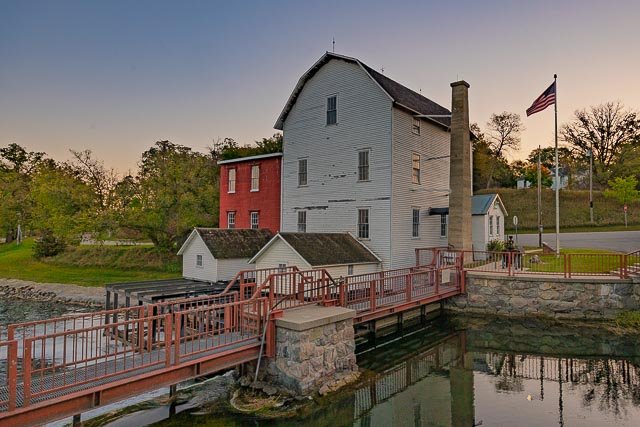
Phelps Mill The Phelps mill was built in 1888–1889 by William E. Thomas, a local entrepreneur who owned a flour and feed business in Fergus Falls. During that time, wheat was a high-demand crop, and nearly one thousand flour mills were in operation throughout Minnesota. Thomas began constructing a wooden dam on the river in the spring of 1888, although the dam was prone to leakage and had to be shored up with sandbags, dirt, gravel, and other materials. The mill itself was built by Royal Powers, who built and framed the mill without using blueprints. He was able to keep the entire plan within his head and did not even have to mark out the lumber he was cutting. The mill opened in October 1889 and was designed to produce 60 to 75 barrels of flour per day. It was very successful during its initial several years of operation, and in 1895 Thomas built an addition to grind buckwheat and rye. Thomas also built a bunkhouse for overnight guests and a barn for stabling horses. A general store also was established in the area and is still in operation. As technology progressed in the early 1900s, though, power from electricity, gasoline, or steam became more efficient for powering mills. Railroad transportation also made it more cost-effective to transport the grain to the Minneapolis-St. Paul area for milling. Thomas sold the mill in 1919, and after another change of ownership in 1928, the mill closed for good in 1939. A local resident and activist, Geneva Tweten, led a campaign to save the mill as a symbol of the rural life. Otter Tail County purchased the site in 1965, and it was listed on the National Register of Historic Places in 1975. The mill is part of the Phelps Mill Historic District, which also includes the general store and an Italianate miller’s house. Where it is: Phelps Mill is  in Otter Tail County, Minnesota, United States, on the Otter Tail River.  29029 County Highway 45, Underwood, Minnesota 56586 Maps:   GPS: 46°22’48.558″ N 95°49’14.502″ W Links: https://ottertailcounty.gov/location/phelps-mill/ Hours: Park Season (May – October) Open to the public daily: 6 am – 10 pm Off-Season (November – April) The park grounds are open on a limited basis in the winter months as weather permits. Facilities are not open and snow is not removed. Cost: There is no cost to visit the Phelps Mill County Park. Location Contact Information: 29035 County Highway 45 Underwood, MN 56586 (218) 826-6159 (800) 423-4571 phelpsmillpark@ottertailcounty.gov Facilities: Areas for fishing along the bank of the Otter Tail River – there are no boat launching facilities Historic mill building Historic pedestrian bridge Modern ADA accessible restrooms – there is no running water in the restrooms Parking Picnic tables Play area for children 5 to 12 years of age Running water and electricity available Two picnic shelters that can be reserved for weddings, family reunions, and picnics Paved walking trails and two elevated boardwalks Phelps Mill Photo Gallery Click Here for full page gallery     More Photographic Destinations in Minnesota Interactive Google Map Use the map  + – controls to zoom in and out, use the Map drop-down to change to “Map”, “Satellite”, “Hybrid”, or “Terrain” views.  Drag the little man icon from the upper left corner to a map location for street level view. Click on a pushpin for more information about the Photographic Destination, then click on the title to go to the location page. Click Here for Photographic Destinations by State [...]Read more...
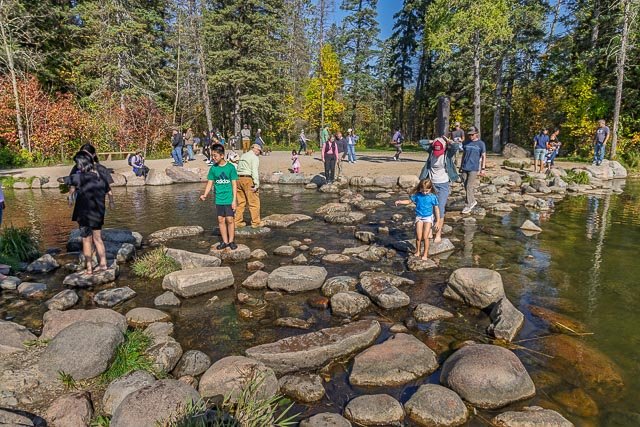
Lake Itasca State Park – Headwaters of the Mississippi Established in 1891, Itasca is Minnesota’s oldest state park. At the heart of the 32,000-acre forest wilderness, the mighty Mississippi River begins its 2,552-mile journey to the gulf. Points of interest include old growth pine forests, over 100 lakes, numerous historic sites and structures, and the headwaters of the Mississippi River. Itasca State Park was established by the Minnesota Legislature on April 20, 1891, making it the first of Minnesota’s state parks and second oldest in the United States, behind Niagara Falls State Park. Henry Schoolcraft determined Lake Itasca as the river’s source in 1832. It was named as a National Natural Landmark in 1965, and was added to the National Register of Historic Places in 1973. About 500,000 people visit Itasca State Park annually. Lake Itasca, the official source of the Mississippi River and a scenic area of northern Minnesota, has remained relatively unchanged from its natural state. Most of the area has a heavy growth of timber that includes virgin red pine, which is also Minnesota’s state tree. Some of the red pine in Itasca are over 200 years old. Scattered around the boundaries of Itasca State Park stand a variety of historical and tourist attractions. Constructed over a 37-year period from 1905 to 1942, development was undertaken by two Civilian Conservation Corps (CCC) camps as well as two Works Progress Administration (WPA) camps. The headwaters of the Mississippi River are clearly defined by a 44 foot long outlet dam at the north end of Lake Itasca. This setup allows tourists to wade in shallow water or cross over it by way of the bridge constructed of logs. Where it is: Itasca State Park  is located about 21 miles (34 km) north of Park Rapids, Minnesota and 25 miles (40 km) from Bagley, Minnesota. Maps:   GPS: 47°14’21.8667″ N 95°12’27.5773″ W Links: Itasca State Park Hours: Daily from 8 a.m. until 10 p.m. Cost: One-day vehicle permit $7 A $35 year-round vehicle permit provides unlimited visits to every Minnesota state park and recreation area for a full year from the month of purchase. Location Contact Information: Itasca State Park 36750 Main Park Drive Park Rapids, MN 56470 218-699-7251 Email:  itasca.statepark@state.mn.us Facilities: Restrooms, cafe, and gift shop are available in the visitor center. Lake Itasca State Park – Headwaters of the Mississippi Photo Gallery Click Here for full page gallery     More Photographic Destinations in Minnesota Interactive Google Map Use the map  + – controls to zoom in and out, use the Map drop-down to change to “Map”, “Satellite”, “Hybrid”, or “Terrain” views.  Drag the little man icon from the upper left corner to a map location for street level view. Click on a pushpin for more information about the Photographic Destination, then click on the title to go to the location page. Click Here for Photographic Destinations by State [...]Read more...