Bird of the Month
Each month I will feature a bird that I have photographed. Not only will I show some of my photos but will also include information about the bird.
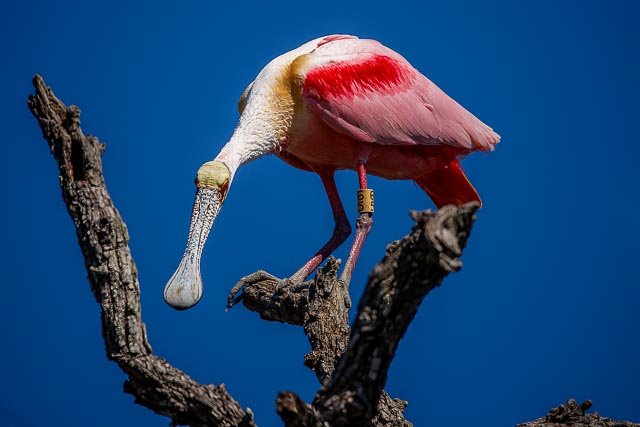
Roseate Spoonbill April 2023 Bird of the Month
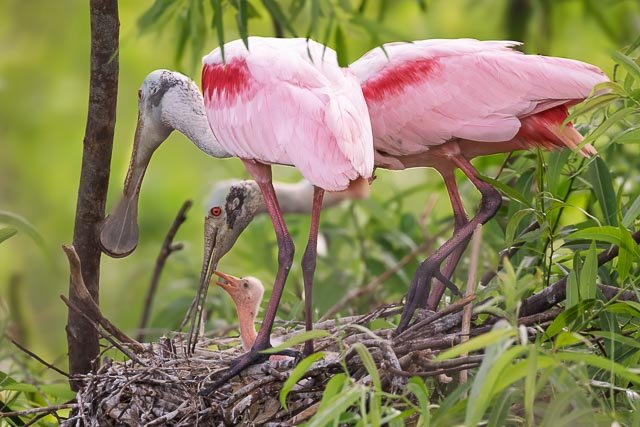
The Roseate Spoonbill is found along the south Florida coast from the Florida Keys north to Tampa, with some populations in northeastern Florida and the eastern coast of Texas down to Mexico. A major period of decline for the spoonbill occurred in the early 1800s when the wings of this beautiful creature were made into fans, a “regular article of trade” in St. Augustine, according to John Audubon. The millinery or “hat trade” also took a heavy toll on the spoonbill in the late 1800s. Although their feathers were never in as great of demand as the plumes of the egrets because they faded, spoonbills were still slaughtered along with many plume birds, and their numbers declined. The establishment of Everglades National Park in 1947 seemed to have a positive affect on south Florida’s spoonbill population, which began reusing nesting sites that hadn’t been occupied since the late 1800s.
The roseate spoonbill (Platalea ajaja) is a social wading bird of the ibis and spoonbill family, Threskiornithidae. It is a resident breeder in both South and North America.
The roseate spoonbill is 28–34 in long, with a 47–52 in wingspan and a body mass of 2.6–4.0 lb. Adults have a bare greenish head (“golden buff” when breeding) and a white neck, back and breast (with a tuft of pink feathers in the center when breeding), and are otherwise a deep pink. The bill is grey. There is no significant sexual dimorphism.
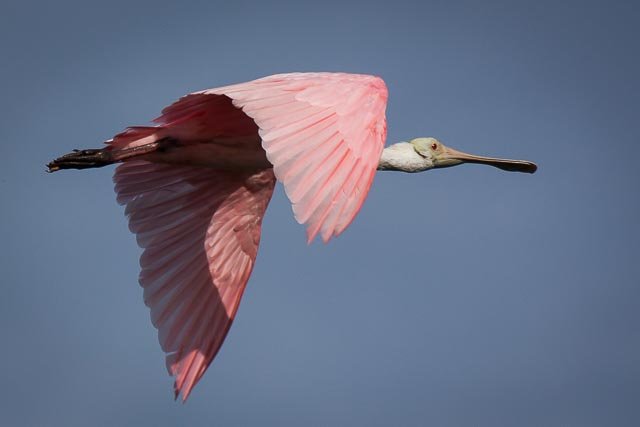
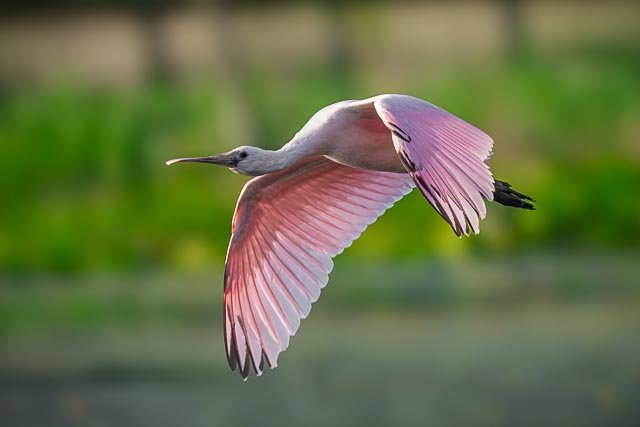
Like the American flamingo, their pink color is diet-derived, consisting of the carotenoid pigment canthaxanthin. Another carotenoid, astaxanthin, can also be found deposited in flight and body feathers. The colors can range from pale pink to bright magenta, depending on age, whether breeding or not, and location. Unlike herons, spoonbills fly with their necks outstretched. They alternate groups of stiff, shallow wingbeats with glides.
In the United States, the species is locally common in Texas, Florida, and southwest Louisiana. Plume hunting in the eighteenth and nineteenth centuries almost drove the roseate spoonbill to extinction. However, following decades of conservation efforts, and the effects of climate change, the range of the roseate spoonbill has expanded considerably in the 21st century.
In the summer of 2021, sightings of the bird were reported well outside its typical range, including in Washington, D.C., upstate New York, and even New Hampshire. A large flock was spotted in Huntley Meadows Park in Fairfax County, Virginia, drawing a large crowd of spectators. The bird has also been spotted in New Jersey with increasing frequency.
In Florida Bay, roseate spoonbills are an ecological and scientific indicator species. The number of nests varies with both the amount of fresh water and the depth of seawater there, as wetlands turn into open ocean. The birds are choosing to nest further north and inland in Florida, with sharp changes in nest locations noted in the years 2006–2020.
This species feeds in shallow fresh or coastal waters by swinging its bill from side to side as it steadily walks through the water, often in groups. Moreover, the spoon-shaped bill allows it to sift easily through mud.
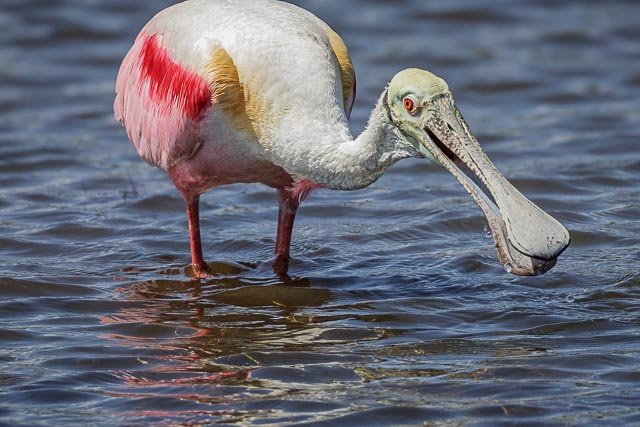
The bird feeds on crustaceans, bits of plant material, aquatic insects, mollusks, frogs, newts and very small fish (such as minnows) ignored by larger waders. Roseate spoonbills must compete for food with other freshwater birds, such as snowy egrets, great egrets, tricolored herons and American white pelicans. Roseate spoonbills are often trailed by egrets when foraging in a commensal “beater-follower” relationship, as the spoonbill’s disturbance of the sediment makes prey more available to the egret.
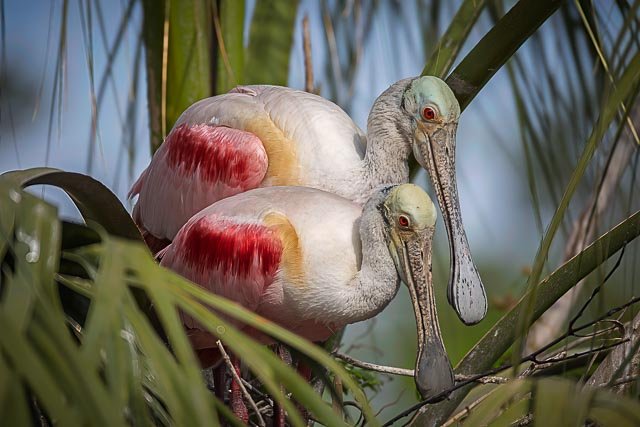
The roseate spoonbill nests in shrubs or trees, often mangroves, laying two to five eggs, which are whitish with brown markings. Immature birds have white, feathered heads, and the pink of the plumage is paler. The bill is yellowish or pinkish. Nestlings are sometimes killed by turkey vultures, bald eagles, raccoons and invasive fire ants.